|
b.
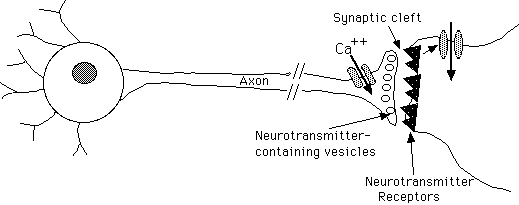
Receptor in postsynaptic membrane The
neurotransmitter diffuses across the synaptic cleft and
binds to a
receptorin
the membrane of the postsynaptic cell. This can be either
the dendrite of another neuron
or the motor end-plate of a muscle cell.
c.
Fast vs slow
In
fastchemical
synapses, the neurotransmitter receptor is directly
coupled to an ion
channel. When the neurotransmitter binds, the
channel opens. These are
known as chemically gated or ligand gated
channels.
In
slowchemical
synapses, the binding of the neurotransmitter to its
receptor triggers a
signal transduction
cascadeinvolving
G-proteins, which
eventually opens the ion channel.
|


 1 2
3 4
5 6
1 2
3 4
5 6