1 2 3 4

system for transport; it moves directly through the ground. It moves too fast (10 cm/hr) for diffusion, so it must be transported at least part of the way. It doesn't move because of gravity; if you change the relative heights of the tips and base of a shoot, auxin will still move towards the base. Auxin moves unidirectionally through the parenchyma cells by polar transport.

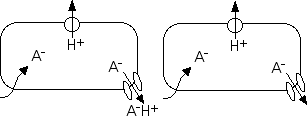
A modelfor auxin transport has been developed. The auxin molecule (indoleacetic acid, IAA) is negatively charged and can't cross the plasma membrane.

When it comes close to the cell wall, it picks up a proton. Now, it is electrically neutral and can diffuse through the cell membrane. One inside, the proton dissociates and the negatively-charged auxin is stuck inside. It can only get out through carrier proteins that are localized to the basal end of the cell.

IMAGE imgs/220C_32Lecture02.gif

ShootTip

A-H+

2. Cell elongation/ acid growth hypothesis39.5 One of auxins major effects is to stimulate the growthof plant cells. Remember, plant cells grow by taking water into the central vacuole. But plant cells are prisoners inside their cell walls. In order to grow they need to modify the cell wall so that it can expand. One hypothesis is that auxin stimulates the proton pumps, which pump out protons and lower the pH of the cell wall. This is why polar transport requires energy. The low pH may cause cross-links between the cellulose microfibrils in the cell wall to break.

This allows the cell wall to be deformed and the cell inside can expand. So, auxins control which cells expand more. This is one of the major mechanisms that the plant can use to alter its shape.
This mechanism of altering plant shape by differential elongation of certain cells allows plants to respond to environmental cues such as light and gravity. For discussion on Genetic engineering in plants
Background: Campbell, 5th, 383-385; (4th, 390-392)

Review: