Multiple Integrals
In this section, I'm going to describe the theoretical background
behind multiple integrals. Even though I'm not going to give proofs,
the terms and definitions are technical, and you don't need to know
them in detail for a course in multivariable calculus. What you
should be able to see is the resemblance to the definition of the
Riemann integral you saw in single-variable calculus. Focus on the
big picture and don't get lost in the technicalities.
In multivariable calculus, we focus on integrals in  (double integrals) and in
  (triple integrals). One point of the discussion here
is that the theory is essentially the same for both --- and for
integrals in higher dimensions, and also for the integrals you've
already seen in your first calculus course. So when we discuss double
or triple integrals, we only have to consider the differences caused
by working in 2 or 3 dimensions.
(triple integrals). One point of the discussion here
is that the theory is essentially the same for both --- and for
integrals in higher dimensions, and also for the integrals you've
already seen in your first calculus course. So when we discuss double
or triple integrals, we only have to consider the differences caused
by working in 2 or 3 dimensions.
Definition. A closed
box in  consists of the set of points
  satisfying a set of inequalities

In this case, we write
![$$B = [a_1, b_1] \times [a_2, b_2] \times \cdots \times [a_n, b_n].$$](multiple-integrals6.png)
This is called an n-fold Cartesian product of
the intervals.
The volume of the box B defined above is

Thus, a box in  is an interval. A box in
  is a rectangle. A box in
  is a rectangular parallelepiped --- i.e. what you
normally think of as a "box" in the real world. And so on
in higher dimensions.
is a rectangular parallelepiped --- i.e. what you
normally think of as a "box" in the real world. And so on
in higher dimensions.

The word "volume" is used generically regardless of the
dimension of the box, just so we have one word for a box's
"size". So the "volume" of an interval ![$[a, b]$](multiple-integrals12.png) is its length
is its length  . The
"volume" of a box
. The
"volume" of a box ![$[a_1, b_1] \times [a_2, b_2]$](multiple-integrals14.png) is its area
is its area  as a rectangle. And so on.
Definition. A partition
of an interval  is a sequence of points

Suppose a closed box B is given by
![$$B = [a_1, b_1] \times [a_2, b_2] \times \cdots \times [a_n, b_n].$$](multiple-integrals18.png)
A partition of B in  consists of a collection of partitions
  ,
,  , ...,
  of
of ![$[a_1,
b_1]$](multiple-integrals23.png) ,
, ![$[a_2, b_2]$](multiple-integrals24.png) , ...,
, ..., ![$[a_n, b_n]$](multiple-integrals25.png) .
.
A partition of B decomposes B into a union of sub-boxes of the form
![$$B' = [s_1, t_1] \times [s_2, t_2] \times \cdots \times [s_n, t_n].$$](multiple-integrals26.png)
Here ![$[s_k, t_k]$](multiple-integrals27.png) is a sub-box in the partition
is a sub-box in the partition  of
of ![$[a_k,
b_k]$](multiple-integrals29.png) .
.
It is easy to get lost in all the variables and subscripts, but the
basic ideas are simple.
You saw partitions of intervals in discussing integrals in
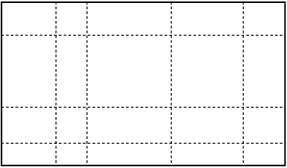
single-variable calculus. A partition of a box is essentially a
decompositon of a box into lots of smaller boxes, which fit together
to make the big box.
Definition. Let X be a set of points in  .
.
(a) The least upper bound of X is the smallest
number which is greater than or equal to all the numbers in X. It is
denoted  .
.
(b) The greatest lower bound of X is the
largest number which is smaller than or equal to all the numbers in
X. It is denoted  .
.

Definition. Let  , and let
  . Then f is bounded
if there is a number M such that
. Then f is bounded
if there is a number M such that  for all
  .
.
Definition. Let B be a box in  , and let
  be a
bounded function. Let P be a partition of B.
be a
bounded function. Let P be a partition of B.
If  is a sub-box of P, let

The lower sum of f on B relative to the
partition P is

The upper sum of f on B relative to the
partition P is

 is roughly the smallest value of f on
  and
and  is roughly the
largest value of f on
is roughly the
largest value of f on  . I say "roughly"
because these values might only be approached by f on
. I say "roughly"
because these values might only be approached by f on  , not attained.
The upper and lower sums are like the upper and lower rectangle sums
you saw in single-variable calculus. There the lower sum was the sum
of rectangles built using the smallest values of f on each
subinterval, and the upper sum was the sum of rectangles built using
the largest values of f on each subinterval.
After all this terminology, I can define the integral of a function.
Definition. Let B be a closed box in  , and let
  . The
function f is integrable if:
. The
function f is integrable if:
(a) f is bounded.
(b)  , where the
  and
and  are taken over all partitions of
B.
are taken over all partitions of
B.
If f is integrable, the common value  is the
integral of f on B and is denoted
is the
integral of f on B and is denoted  .
.
Note that " " doesn't have any variables in it. When we evaluate an integral
as an iterated integral, we'll introduce
variables as usual. But it's worth remembering that the variables in
an integral are "dummy variables" --- so, for example,
" doesn't have any variables in it. When we evaluate an integral
as an iterated integral, we'll introduce
variables as usual. But it's worth remembering that the variables in
an integral are "dummy variables" --- so, for example,

The definition of integrable function can be
hard to use directly. For many applications the following result is
more easily applicable.
Theorem. Let B be a closed box in  , and let
  be a
bounded function.
be a
bounded function.
f is integrable if and only if the points of discontinuity of f form
a set of measure 0.
A set has measure 0 if, roughly speaking, it
is "small" relative to its containing space. Some easy
examples: A finite set of points has measure 0. In  , the boundary of a closed rectangle has measure 0.
Thus, this result says a bounded function without "too
many" discontinuities is integrable.
Many of the usual properties of integrals hold.
Theorem. Let B be a box in  , let
, let  be integrable
functions on B, and let
be integrable
functions on B, and let  . Then:
(a)  .
.
(b)  .
.
(c) If  for all
  , then

Suppose you want to integrate over a set A which is not a closed
rectangle. The characteristic function of A is

Thus,  is "on" (equal to 1) if you're in
A, and is "off" (equal to 0) if you're not.
is "on" (equal to 1) if you're in
A, and is "off" (equal to 0) if you're not.
If f is integrable on a closed box B and  , the integral of f on A is defined by


As long as A is reasonably behaved, f will be integrable on A.
Specifically, f is integrable on A if and only if the boundary of A has measure 0
(terminology I've discussed above).
Contact information
Bruce Ikenaga's Home Page
Copyright 2018 by Bruce Ikenaga