 , where d is a positive integer
which is not a perfect square. Let's recall some earlier results
we'll need.
, where d is a positive integer
which is not a perfect square. Let's recall some earlier results
we'll need.
In this section I'll consider continued fractions for quadratic
irrationals of the form , where d is a positive integer
which is not a perfect square. Let's recall some earlier results
we'll need.
We have an algorithm for constructing the continued fraction for a
quadratic irrational. Suppose a quadratic irrational has been written
in the form  , where:
(a)  and
and  .
.
(b)  .
.
(c) d is a positive integer which is not a perfect square.
Set
![$$m_0 = m, \quad s_0 = s, \quad x_0 = x, \quad a_0 = [x_0].$$](continued-fractions-for-square-roots6.png)
Then for  , define (in order)
![$$\eqalign{ m_{k + 1} & = a_k s_k - m_k \cr \noalign{\vskip2pt} s_{k + 1} & = \dfrac{d - m_{k + 1}^2}{s_k} \cr \noalign{\vskip2pt} x_{k + 1} & = \dfrac{m_{k + 1} + \sqrt{d}}{s_{k + 1}} \cr \noalign{\vskip2pt} a_{k + 1} & = [x_{k + 1}] \cr}$$](continued-fractions-for-square-roots8.png)
The continued fraction for x is ![$[a_0, a_1, a_2,
\ldots]$](continued-fractions-for-square-roots9.png) , and it is known to be
periodic.
, and it is known to be
periodic.
In the case of  where d is a
positive integer which is not a perfect square, I may take
where d is a
positive integer which is not a perfect square, I may take  and
and  .
.
The main result establishes the form of the continued fraction for
 . To state it, I
need a definition.
. To state it, I
need a definition.
Definition. A sequence of numbers  is
palindromic if
is
palindromic if  for
for  .
.
The empty sequence is considered to be palindromic.
For example, the following sequences are palindromic:

Theorem. Let d be a positive integer which is not a perfect square.
(a) The continued fraction for  has the form
![$$\sqrt{d} = [a_0, \overline{a_1, \ldots a_{n - 1}, 2 a_0}].$$](continued-fractions-for-square-roots19.png)
(b) The sequence  is palindromic.
To illustrate, here is the continued fraction for  :
:
![$$\sqrt{53} = [7, 3, 1, 1, 3, 14, 3, 1, 1, 3, 14, \ldots].$$](continued-fractions-for-square-roots22.png)
Note that  , and
, and  is palindromic.
Likewise,
![$$\sqrt{52} = [7, 4, 1, 2, 1, 4, 14, 4, 1, 2, 1, 4, 14, \ldots].$$](continued-fractions-for-square-roots25.png)
Note that  and
and  is palindromic.
The proof of the theorem will use two theorems of Galois on purely periodic continued fractions which we proved earlier:
![$x =
[a_0, a_1, \ldots]$](continued-fractions-for-square-roots28.png) be a
quadratic irrational. The continued fraction for x is purely periodic
if and only if
be a
quadratic irrational. The continued fraction for x is purely periodic
if and only if  and
and  .
.
![$x =
[\overline{a_0, a_1, \ldots a_{n - 1}, a_n}]$](continued-fractions-for-square-roots31.png) be a purely periodic quadratic irrational. Then
be a purely periodic quadratic irrational. Then  is purely periodic, and
![$$-\dfrac{1}{\overline{x}} = [\overline{a_n, a_{n - 1}, \ldots a_1, a_0}].$$](continued-fractions-for-square-roots33.png)
Proof. (a) Step 1.
We'll show: The continued fraction for ![$\sqrt{d} +
[\sqrt{d}]$](continued-fractions-for-square-roots34.png) is purely periodic.
is purely periodic.
Recall that ![$[\cdot]$](continued-fractions-for-square-roots35.png) denotes the
greatest integer function.
denotes the
greatest integer function.
Since d is a positive integer and is not a perfect square,  and
and
![$$\sqrt{d} + [\sqrt{d}] > 1.$$](continued-fractions-for-square-roots37.png)
The conjugate is ![$[\sqrt{d}] -
\sqrt{d}$](continued-fractions-for-square-roots38.png) . Since
. Since  is not an integer,
![$$[\sqrt{d}] < \sqrt{d} < [\sqrt{d}] + 1.$$](continued-fractions-for-square-roots40.png)
The first of these two inequalities gives ![$[\sqrt{d}] -
\sqrt{d} < 0$](continued-fractions-for-square-roots41.png) . The second of
these two inequalities gives
. The second of
these two inequalities gives
![$$\eqalign{ \sqrt{d} - [\sqrt{d}] & < 1 \cr [\sqrt{d}] - \sqrt{d} & > -1 \cr}$$.](continued-fractions-for-square-roots42.png)
All together, the conjugate satisfies
![$$-1 < [\sqrt{d}] - \sqrt{d} < 0.$$](continued-fractions-for-square-roots43.png)
We showed above that ![$\sqrt{d} +
[\sqrt{d}] > 1$](continued-fractions-for-square-roots44.png) , so the
hypotheses of the first of Galois's theorems is satisfied. Hence,
, so the
hypotheses of the first of Galois's theorems is satisfied. Hence,
![$\sqrt{d}
+ [\sqrt{d}]$](continued-fractions-for-square-roots45.png) is purely periodic.
This completes the proof of Step 1.
is purely periodic.
This completes the proof of Step 1.
Step 2. We'll show: The continued fraction for
 has the form
![$$\sqrt{d} = [a_0, \overline{a_1, \ldots a_{n - 1}, 2 a_0}].$$](continued-fractions-for-square-roots47.png)
Suppose the period of the continued fraction for ![$\sqrt{d} +
[\sqrt{d}]$](continued-fractions-for-square-roots48.png) is n. We write
is n. We write
![$$\sqrt{d} + [\sqrt{d}] = [\overline{a_0, a_1, \ldots, a_{n - 1}}].$$](continued-fractions-for-square-roots49.png)
Then
![$$a_0 = \left[\sqrt{d} + [\sqrt{d}]\right] = 2 [\sqrt{d}].$$](continued-fractions-for-square-roots50.png)
Thus,
![$$\sqrt{d} + [\sqrt{d}] = [\overline{2 [\sqrt{d}], a_1, \ldots, a_{n - 1}}] = [2 [\sqrt{d}], a_1, \ldots, a_{n - 1}, \overline{2 [\sqrt{d}], a_1, \ldots, a_{n - 1}}].$$](continued-fractions-for-square-roots51.png)
Note that this is purely periodic, as we knew from Step 1. Moreover,
it shows that if the period for the continued fraction for  is n, the same is true for the
continued fraction for
is n, the same is true for the
continued fraction for ![$[\sqrt{d}] +
\sqrt{d}$](continued-fractions-for-square-roots53.png) .
.
Subtract ![$[\sqrt{d}]$](continued-fractions-for-square-roots54.png) from both sides
to obtain
from both sides
to obtain
![$$\sqrt{d} = [[\sqrt{d}], a_1, \ldots, a_{n - 1}, 2 [\sqrt{d}], \overline{a_1, \ldots, a_{n - 1}, 2 [\sqrt{d}]}].$$](continued-fractions-for-square-roots55.png)
That is, the repeating part is ![$\{a_1, \ldots,
a_{n - 1}, 2 [\sqrt{d}]\}$](continued-fractions-for-square-roots56.png) . The
continued fraction has the form claimed.
. The
continued fraction has the form claimed.
Note that the infinite continued fraction for an irrational number is
unique. So  , ...,
  are the same a's we'd have
obtained if we'd computed the continued fraction for
are the same a's we'd have
obtained if we'd computed the continued fraction for  using the standard algorithm.
This completes the proof of part (a).
(b) By the proof of (a), the continued fraction for ![$\sqrt{d} +
[\sqrt{d}]$](continued-fractions-for-square-roots60.png) is purely periodic.
So suppose that
is purely periodic.
So suppose that
![$$\sqrt{d} + [\sqrt{d}] = [\overline{a_0, a_1, \ldots, a_{n - 1}}].$$](continued-fractions-for-square-roots61.png)
I showed in the proof of (a) that
![$$\sqrt{d} = \left[[\sqrt{d}], \overline{a_1, \ldots, a_{n - 1}, 2 [\sqrt{d}]}]\right].$$](continued-fractions-for-square-roots62.png)
Since ![$\sqrt{d} + [\sqrt{d}]$](continued-fractions-for-square-roots63.png) is
purely periodic, the second theorem of Galois shows that
is
purely periodic, the second theorem of Galois shows that ![$\dfrac{-1}{\overline{\sqrt{d} + [\sqrt{d}]}} =
\dfrac{1}{\sqrt{d} - [\sqrt{d}]}$](continued-fractions-for-square-roots64.png) is purely periodic, and
is purely periodic, and
![$$\dfrac{1}{\sqrt{d} - [\sqrt{d}]} = [\overline{a_{n - 1}, \ldots, a_1, a_0}].$$](continued-fractions-for-square-roots65.png)
But
![$$\sqrt{d} - [\sqrt{d}] = [0, \overline{a_1, \ldots, a_{n - 1}, 2 [\sqrt{d}]}] = \dfrac{1}{\overline{a_1, \ldots, a_{n - 1}, 2 [\sqrt{d}]}}.$$](continued-fractions-for-square-roots66.png)
Hence,
![$$\dfrac{1}{\sqrt{d} - [\sqrt{d}]} = [\overline{a_1, \ldots, a_{n - 1}, 2 [\sqrt{d}]}].$$](continued-fractions-for-square-roots67.png)
Equating the terms in two expressions for ![$\dfrac{1}{\sqrt{d} - [\sqrt{d}]}$](continued-fractions-for-square-roots68.png) , I obtain the equations
, I obtain the equations

This shows that the sequence  is palindromic.
The following refinement of the Theorem will be used in our discussion of the Fermat-Pell equation. We refer to the algorithm for the continued fraction of a quadratic irrational --- "the quadratic irrational algorithm", for short --- described at the beginning of this section.
Proposition. Let d be a positive integer which is not a perfect square. Suppose the quadratic irrational algorithm is applied to:
(1)  , producing
sequences
, producing
sequences  ,
,  ,
,  , and
, and  .
.
(2) ![$[\sqrt{d}] + \sqrt{d}$](continued-fractions-for-square-roots76.png) ,
producing sequences
,
producing sequences  ,
,  ,
,  , and
, and  .
.
Then:
(a)  for
for  .
.
(b)  for
for  .
.
(c)  for
for  .
.
(d)  for
for  , and
, and  .
.
Proof. In the proof of part (a) of the preceding theorem, we showed that
![$$\sqrt{d} = \left[[\sqrt{d}], \overline{a_1, \ldots, a_{n - 1}, 2 a_0} \right] = \left[[\sqrt{d}], a_1, \ldots, a_{n - 1}, 2 [\sqrt{d}], a_1, \ldots, a_{n - 1}, 2 [\sqrt{d}], \ldots \right].$$](continued-fractions-for-square-roots90.png)
![$$[\sqrt{d}] + \sqrt{d} = \left[\overline{[2 \sqrt{d}], a_1, \ldots, a_{n - 1}} \right] = \left[2 [\sqrt{d}], a_1, \ldots, a_{n - 1}, 2 [\sqrt{d}], a_1, \ldots, a_{n - 1}, 2 [\sqrt{d}], \ldots \right].$$](continued-fractions-for-square-roots91.png)
Comparing terms, we see that (d) follows immediately.
In applying the quadratic irrational algorithm as in (1) and (2), we start with
![$$m_0 = 0, \quad s_0 = 1, \quad x_0 = \sqrt{d}, \quad a_0 = [\sqrt{d}],$$](continued-fractions-for-square-roots92.png)
![$$m_0' = [\sqrt{d}], \quad s_0' = 1, \quad x_0' = [\sqrt{d}] + \sqrt{d}, \quad a_0' = 2[\sqrt{d}].$$](continued-fractions-for-square-roots93.png)
In particular, we have  .
.
In addition,
![$$m_1 = a_0 s_0 - m_0 = [\sqrt{d}] \cdot 1 - 0 = [\sqrt{d}],$$](continued-fractions-for-square-roots95.png)
![$$s_1 = \dfrac{d - m_1^2}{s_0} = \dfrac{d - [\sqrt{d}]^2}{1} = d - [\sqrt{d}]^2$$,](continued-fractions-for-square-roots96.png)
![$$x_1 = \dfrac{m_1 + \sqrt{d}}{s_1} = \dfrac{[\sqrt{d}] + \sqrt{d}}{d - [\sqrt{d}]^2},$$](continued-fractions-for-square-roots97.png)
![$$m_1' = a_0' s_0' - m_0' = 2 [\sqrt{d}] \cdot 1 - [\sqrt{d}] = [\sqrt{d}],$$](continued-fractions-for-square-roots98.png)
![$$s_1' = \dfrac{d - m_1'^2}{s_0'} = \dfrac{d - [\sqrt{d}]^2}{1} = d - [\sqrt{d}]^2$$,](continued-fractions-for-square-roots99.png)
![$$x_1' = \dfrac{m_1' + \sqrt{d}}{s_1'} = \dfrac{[\sqrt{d}] + \sqrt{d}}{d - [\sqrt{d}]^2}.$$](continued-fractions-for-square-roots100.png)
Thus,  ,
,  , and
, and  .
.
Suppose inductively that for some  ,
,

Then



By induction,  for
for  ,
,  for
for  , and
, and  for
for  . This proves (a), (b), and
(c).
. This proves (a), (b), and
(c).
Here's an example which illustrates the result. Here are the first
few values of m, s, x, and a for  :
:
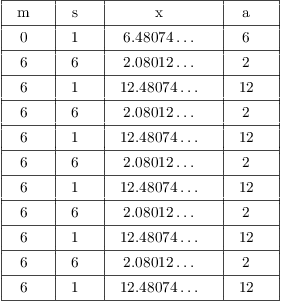
And here are the corresponding values of m, s, x, and a for ![$[\sqrt{42}] +
\sqrt{42}$](continued-fractions-for-square-roots117.png) :
:
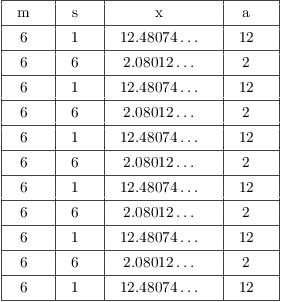
You can see that the m's, x's, and a's agree beginning with the second line (index 1), and the s's agree from the start (index 0).
Proposition. Let d be a positive integer which
is not a perfect square, and suppose ![$[\sqrt{d}] +
\sqrt{d}$](continued-fractions-for-square-roots119.png) has period n:
has period n:
![$$[\sqrt{d}] + \sqrt{d} = [\overline{a_0, a_1, \ldots, a_{n - 1}}].$$](continued-fractions-for-square-roots120.png)
Suppose the quadratic irrational algorithm is applied to ![$[\sqrt{d}] +
\sqrt{d}$](continued-fractions-for-square-roots121.png) , generating sequences
, generating sequences
 ,
,  , and
, and  . Then:
(a)  is purely periodic
with period n.
is purely periodic
with period n.
(b)  .
.
Proof. (a) We saw in the derivation of the
quadratic irrational algorithm that the  's produced by the algorithm are
the same as the
's produced by the algorithm are
the same as the  's in the general continued
fraction algorithm --- that is,
's in the general continued
fraction algorithm --- that is,  in the quadratic irrational
algorithm is the
in the quadratic irrational
algorithm is the  partial quotient of
 ![$[\sqrt{d}] +
\sqrt{d}$](continued-fractions-for-square-roots131.png) . The
. The  's are purely periodic with period
n:
's are purely periodic with period
n:
![$$x = x_0 = [a_0, a_1, \ldots a_{n - 1}, a_0, a_1, \ldots a_{n - 1}, \ldots].$$](continued-fractions-for-square-roots133.png)
But
![$$[a_0, a_1, \ldots a_{n - 1}, a_0, a_1, \ldots a_{n - 1}, \ldots] = [a_0, a_1, \ldots a_{n - 1}, x_n].$$](continued-fractions-for-square-roots134.png)
Comparing the two expansions, we see that
![$$x_n = [a_0, a_1, \ldots a_{n - 1}, \cdots] = x_0.$$](continued-fractions-for-square-roots135.png)
On the other hand, if the  's repeat in n steps, then
 ![$a_i = [x_i]$](continued-fractions-for-square-roots137.png) shows that the a's repeat in n
steps as well. So the a's and x's have the same period, and
shows that the a's repeat in n
steps as well. So the a's and x's have the same period, and  is purely periodic with period n.
(b) Suppose on the contrary that  where
where  . Then
![$$[\overline{a_0, a_1, \ldots, a_{n - 1}}] = [\overline{a_i, a_{i + 1}, \ldots, a_{i + n - 1}}].$$](continued-fractions-for-square-roots141.png)
Thus,

Hence,
![$$[\sqrt{d}] + \sqrt{d} = [\overline{a_0, a_1, \ldots, a_{i - 1}}].$$](continued-fractions-for-square-roots143.png)
But then ![$[\sqrt{d}] + \sqrt{d}$](continued-fractions-for-square-roots144.png) has
period
has
period  , contradicting our
assumption that the period is n.
, contradicting our
assumption that the period is n.
Note that by periodicity,  if
if  .
.
The next result will be used in our discussion of the Fermat-Pell equation.
Theorem. Let d be a positive integer which is
not a perfect square. Suppose the period of  is n, so
![$$\sqrt{d} = [a_0, \overline{a_1. \ldots, a_{n - 1}, 2 a_0}].$$](continued-fractions-for-square-roots149.png)
If the quadratic irrational algorithm is applied to  , generating sequences
  ,
,  ,
,  , then:
(a)  if and only if
  for
for  .
.
(b)  for all i.
Proof. (a) The continued fraction for ![$[\sqrt{d}] +
\sqrt{d}$](continued-fractions-for-square-roots158.png) is purely periodic with
period n. Consequently, if the quadratic irrational algorithm is
applied for
is purely periodic with
period n. Consequently, if the quadratic irrational algorithm is
applied for ![$[\sqrt{d}] + \sqrt{d}$](continued-fractions-for-square-roots159.png) generating sequences
generating sequences  ,
,  ,
,  , then
  for
for  .
.
In our discussion of the quadratic irrational algorithm, we showed
that  if and only if
 . Hence,
 for
for  . But the second-to-the-last
proposition above shows that
. But the second-to-the-last
proposition above shows that  for
for  . Therefore,
  for
for  .
.
Conversely, suppose  . Then
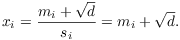
If  , we're done. Otherwise,
  , so again by the
second-to-the-last proposition above,
, so again by the
second-to-the-last proposition above,

Since  is generated from
![$[\sqrt{d}] + \sqrt{d}$](continued-fractions-for-square-roots179.png) , an
earlier result shows that the sequence
, an
earlier result shows that the sequence  is purely periodic. By Galois's
theorem, the conjugate of
is purely periodic. By Galois's
theorem, the conjugate of  satisfies

Thus, ![$m_i = [\sqrt{d}]$](continued-fractions-for-square-roots183.png) . It
follows that
. It
follows that
![$$x_i' = [\sqrt{d}] + \sqrt{d} = x_0'.$$](continued-fractions-for-square-roots184.png)
Therefore,  by the preceding
result.
by the preceding
result.
(b) Suppose on the contrary that  . Then
  (since
  ) and
) and
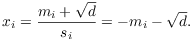
Since  , I have

But  is purely periodic,
so our results on purely periodic continued fractions give
is purely periodic,
so our results on purely periodic continued fractions give

The first inequality gives  , while the second
inequality gives
, while the second
inequality gives  . Together, these give
  , a
contradiction. Therefore,
, a
contradiction. Therefore,  for all i.
It isn't true in general that for period n we have  . For instance, here's a
quadratic irrational with period 3:
. For instance, here's a
quadratic irrational with period 3:
![$$\dfrac{-11 + \sqrt{37}}{-4} = [1, 4, \overline{2, 1, 3}].$$](continued-fractions-for-square-roots199.png)
We have:
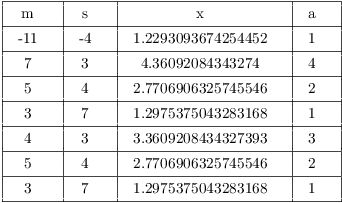
We don't have  and we don't have
 ,
,  , and so on.
Copyright 2026 by Bruce Ikenaga