|
Those are things that
shouldbe allowed to
cross the membrane.
Q. But
should the membrane be porous like a sieve?
What kinds of things should
notbe allowed to cross
membranes? - basically the cell contents
Q. What
kind of structure can satisfy all these requirements?
Small, uncharged molecules pass freely
Specific large and/or charged molecules pass only with
help
B.
Basics of membrane
structure8.5
There may be other solutions, but
let's look at the solution to this problem that evolved on
this planet.
Fig
8.5This is a cartoon of
an animal cell's plasma membrane. Q. What would be different
if it was a plant cell?
- only the extracellular matrix/cell wall
The
basic concept of the plasma membrane is that of protein
"icebergs" floating in a "sea" of lipids. This is known as
the Fluid Mosaic Model.
The 2
components (lipids and proteins) both play a role in
permeability
1.
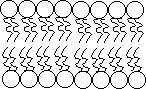
The lipid bilayer is
amphipathic8.1
The lipid
bilayeris made up of
lipid molecules containing long hydrocarbon
chains (hydrophobic) connected
to a charged head group (hydrophilic), which makes it
amphipathic. The bilayer provides a barrier to
large and charged molecules,
which cannot pass through the hydrophobic region.
|


 1 2 3
4 5
6 7
1 2 3
4 5
6 7