1 2 3 4 5 6 7

Q. How can you tell if a substance is being moved by active or passive transport?
See if substance can move up conc. gradient, Block ATP hydrolysis

2. Proton pump (plants)
3. Electrogenic pumps and membrane potential

8.16

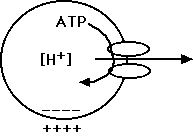
Fig 8.16An important example of active transport in plants is the proton pump.
The proton pump uses the energy of ATP hydrolysis to power the transport of protons out of the cell. This creates a concentration gradientand also an electrical charge differencebetween the inside and the outside of the plasma membrane. This difference in electrical charge is called the membrane potential. Transport proteins that contribute to the membrane potential are called electrogenic pumps.

IMAGE imgs/220C_05Lecture12.gif

[H+]

This is an unbalanced situation, like a bucket of water balanced on top of a door. It took work to get it up there, and that work is just waiting to dump the water on top of whoever opens the door. The potential energyin the proton concentration gradient and the charge gradient can be used to move other things.

4. Cotransport

8.17

Fig 8.16In plants, the movement of protons back into the cell is used to bring sucrose in.

Q. If you have plant cells in a solution and you add sucrose, what happens to the pH of the surrounding solution as the sucrose is moved into the cells? [H+] decreases, pH increases