|
The
rateof diffusion is
dependent on:
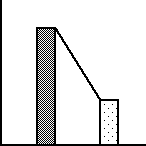
(1) the permeability of the
barrier (how easy it is to get across) (2) the area and
thickness of the barrier
(larger area allows more
transfer, greater thickness reduces transfer) (3) the
magnitude of the concentration gradient
Fig
8.9 R One of the
important things about diffusion to remember is that the
molecules of substance A don't care about the concentrations
of substance B. They both move independently.
Fig
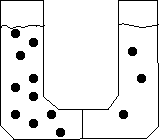
8.10Osmosisis
a special name given to the diffusion of water. At a
superficial level, it appears
that water violates the rule I just gave you. Here is an
illustration of the movement of water across a membrane.
Both sides initially have roughly the same number of
molecules of water, yet water will move from a region of
lower total solute concentration into a region with higher
total solute concentration. If the solute can't pass through
the membrane, more water will end up on one side.
|


 1 2
3 4 5
6 7
1 2
3 4 5
6 7